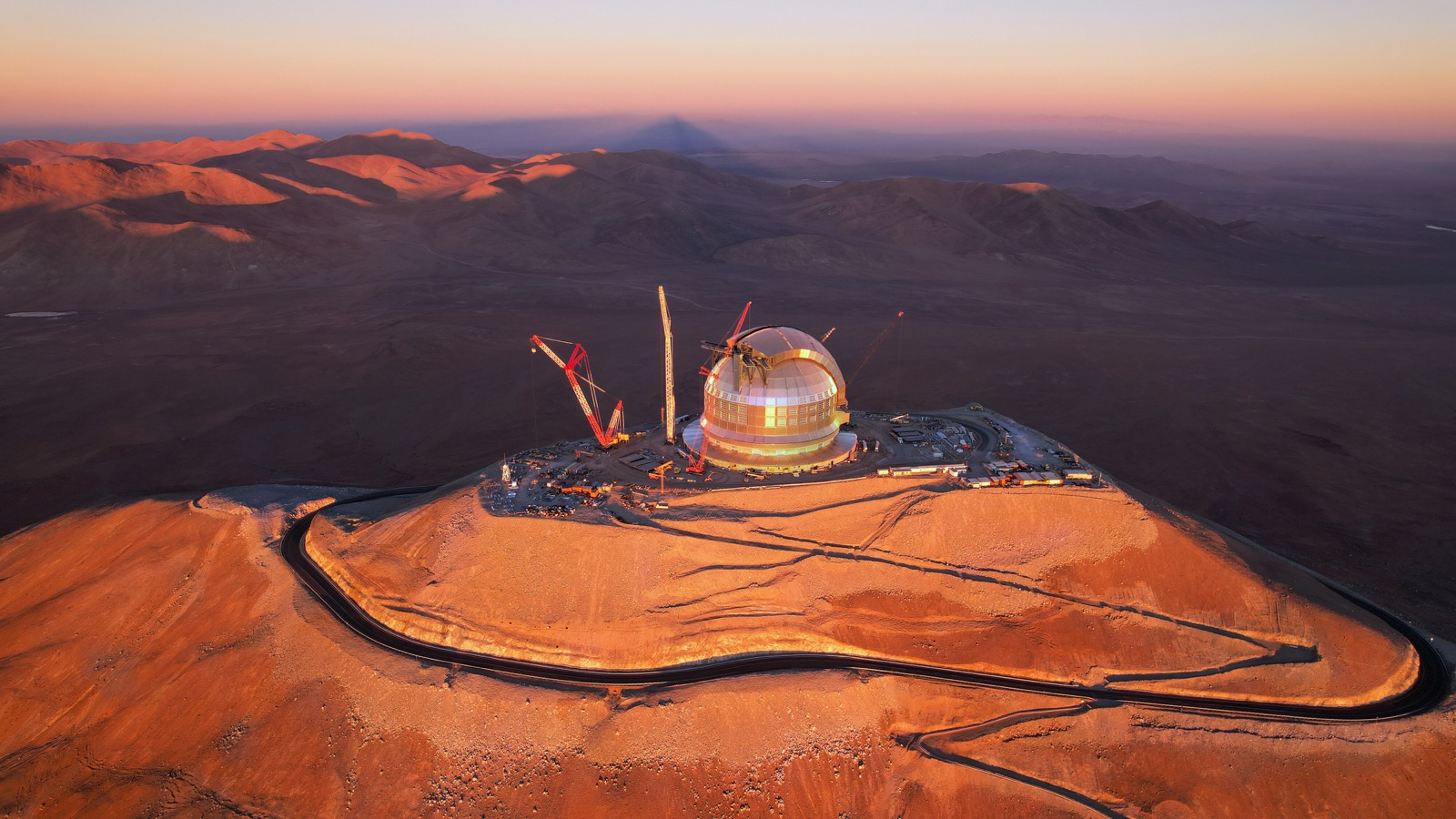
Welcome!

Hello,
My name is Annalisa De Cia, and I’m an astronomer at the European Southern Observatory (ESO) in Garching, Germany.
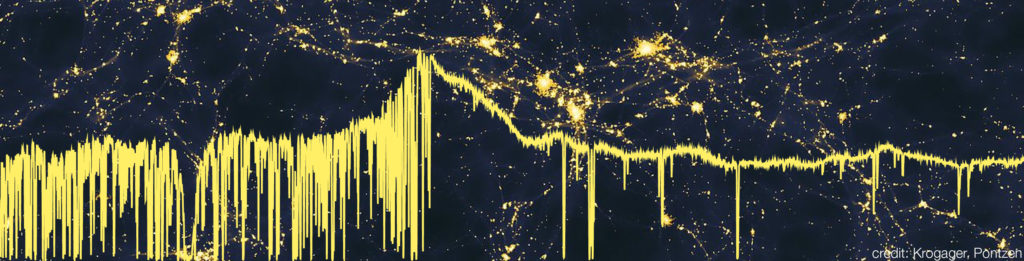
I study galaxies, in particular gas, “metals” (that’s how we call all the chemical elements in the Universe that are heavier than helium) and dust in nearby and distant galaxies using background sources, such as stars, quasars, or gamma-ray bursts, to shine through them. I investigate the chemical properties of gas inside and around galaxies to learn about the chemical evolution of galaxies and the Universe.
I’m the PI of STIS-ISM, a Large Programme with the Hubble Space Telescope to survey the gas between the stars of our Milky Way (the Interstellar Medium), and the Project Scientist for the HWO PEGASUS concept, a high-resolution ultraviolet spectrograph for NASA’s future Habitable Worlds Observatory.
Between 2020 and 2024 I was a professor at the University of Geneva, having been awarded a PRIMA grant by the Swiss National Science Foundation to build the INTERSTELLAR ONE research group.
News
- 2026-09-08Our paper on HWO PEGASUS, a high-resolution UV spectrograph concept for the Habitable Worlds Observatory, is out on arXiv.
- 2025-09-01A warm welcome to Fernanda Muñoz-Olivares, who started her PhD at ESO in Garching! She will study the gas in and around galaxies, the interstellar and circumgalactic medium, and how massive stars chemically enrich their surroundings.
- 2024-10-30Congratulations to Christina Konstantopoulou, who defended her PhD thesis “Characterizing dust depletion and the properties of dust in galaxies throughout cosmic time” at the University of Geneva! Read the thesis
- 2024-10-24Congratulations to Tanita Ramburuth-Hurt on completing her PhD at the University of Geneva!
- 2024-07-09With great sadness we learned that our dear collaborator Edward (Ed) B. Jenkins passed away, at the age of 85. Ed was one of the foremost experts on ultraviolet absorption-line spectroscopy of the interstellar medium, and his work on how elements deplete into dust is a foundation of much of our own research. We will deeply miss his insight, his generosity and his kindness. Princeton’s tribute to Ed
- 2024-07-08Our Hubble Space Telescope Large Programme STIS-ISM was approved: 111 orbits with the STIS spectrograph to survey the interstellar gas of the Milky Way.
- 2023-06-29The Interstellar One group meeting all in person after a while, wonderful! And even better with JK (previous member) visiting.
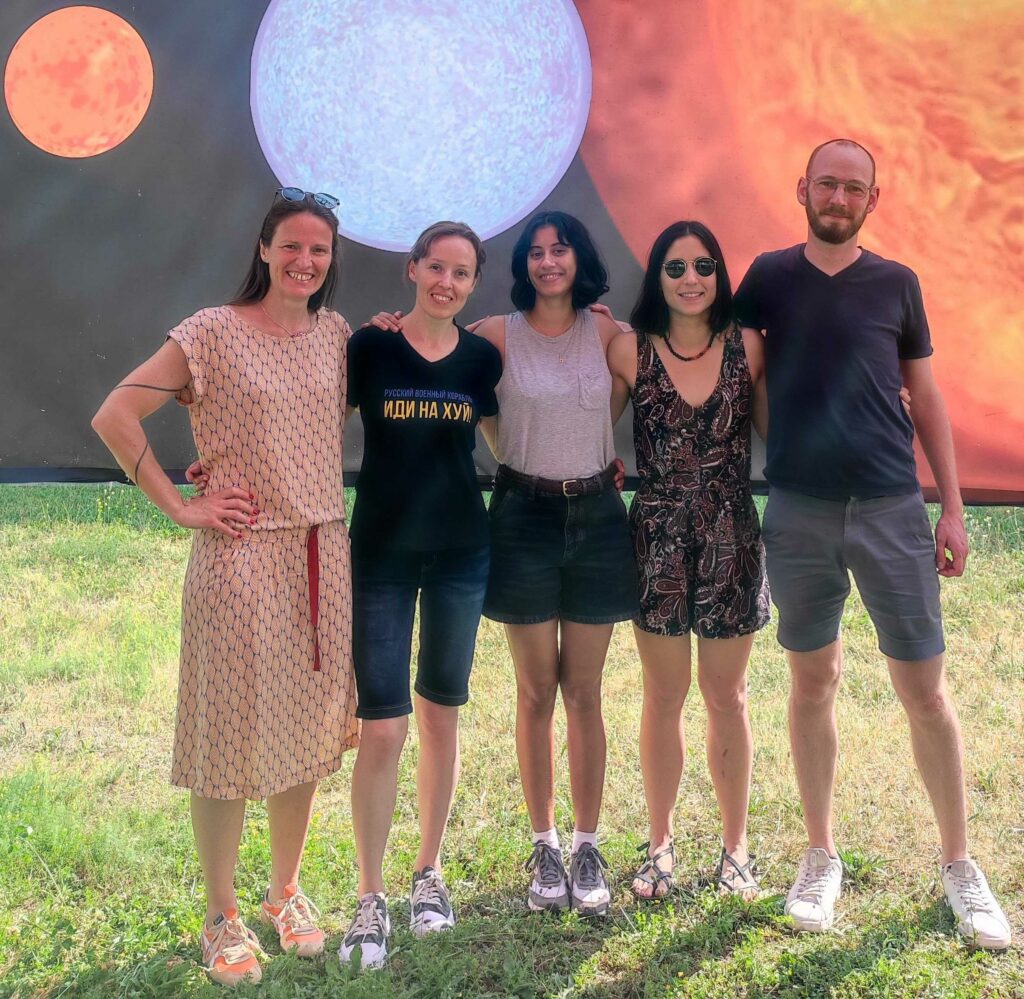
The Interstellar One group, June 2023. - 2023-03-29The paper led by Tanita Ramburuth-Hurt on the chemical diversity within distant galaxies has been published in A&A. Galaxies are not chemically homogeneous!
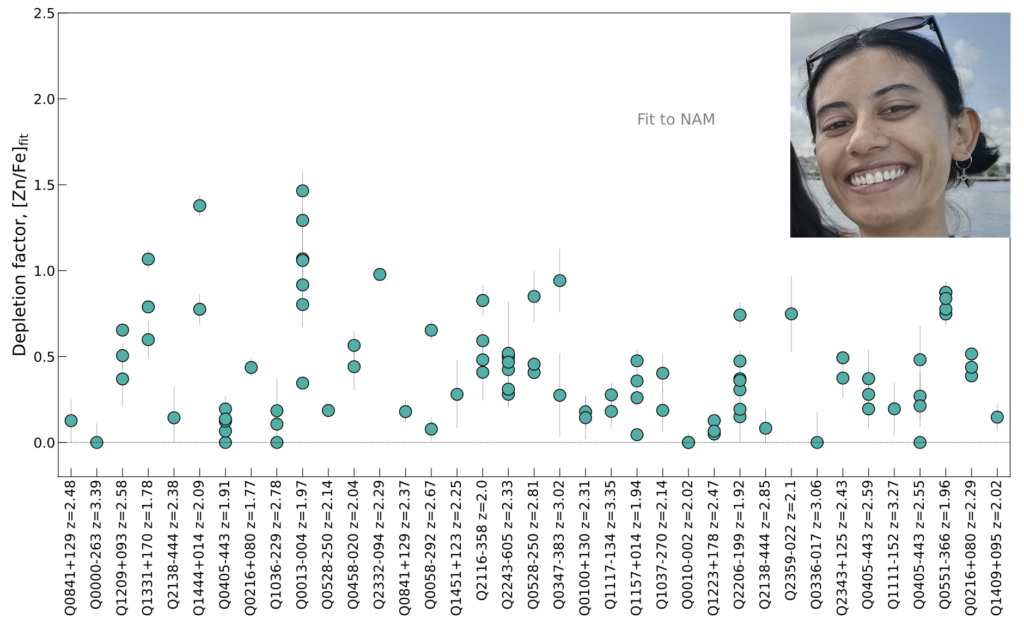
Ramburuth-Hurt et al. 2023. - 2023-01-01Annalisa moved to ESO in Garching, Germany. Excited for this new chapter!
- 2022-09-30The paper led by Christina Konstantopoulou characterizing the dust depletion of 18 metals from the Milky Way to distant galaxies is published in A&A today, check it out here.
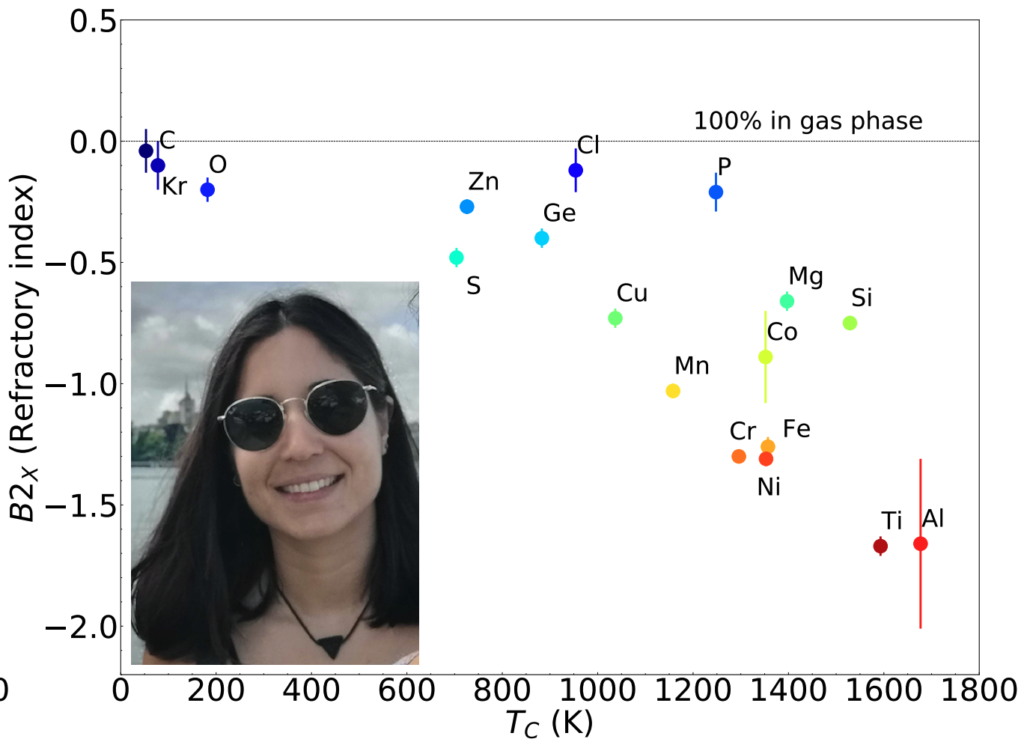
Konstantopoulou et al. 2022. - 2022-08-01A warm welcome to Anna Velichko in our group! As part of her postdoc, she will study the chemical properties of the neutral ISM in galaxies, and compare them to the chemical properties of stars. We are glad she managed to escape the war in Ukraine to work with us!
Anna Velichko. - 2021-09-08Our Milky Way? Not well stirred! Our article “Large Metallicity Variations in the Galactic Interstellar Medium” is now published in Nature.
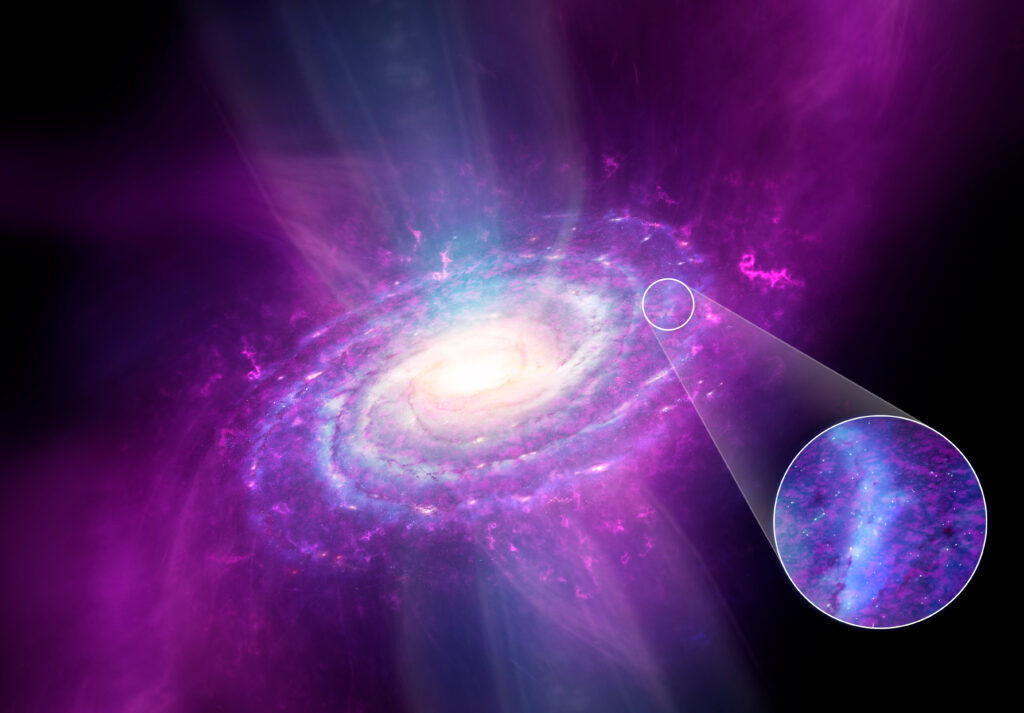
Artistic impression of our Milky Way. Pristine gas (magenta) accretes on the Galactic disk, but does not efficiently mix (zoomed-in patches). Image credit: Dr. Mark Garlick.
Our Milky Way? Not well stirred
Large variations in the chemical composition of the gaseous disk of the Milky Way, which was hitherto assumed to be homogeneous.
Stars and planets in our Galaxy form from the Interstellar Medium (ISM) gas, whose chemical composition is therefore crucial. It is usually assumed that the gas is well stirred and the amount of chemical elements in the ISM increases progressively with time because dying stars expel more and more chemical elements in their outskirts. Indeed, observations show that the metallicity (the amount of elements heavier than He with respect to H) of stars in the Milky Way spans several orders of magnitude, because stars formed at different times in the Galactic history. Contrary to the expectations of a homogeneous ISM, however, we found large variations in the chemical composition of the Galactic gaseous disk.
Until recently, chemical-abundance measurements in the neutral ISM were complicated by the presence of cosmic dust and a phenomenon called dust depletion: large fractions of certain elements are missing from the gas because they have been incorporated into very small particles of dust. Because of this difficulty, until recently most observational and theoretical works have assumed that the metallicity of the neutral ISM in the vicinity of the Sun is the same as in the Sun, and is well mixed. In our work we used a new method for dust correction and could directly measure the metallicity of the neutral ISM in our Galaxy from new UV Hubble Space Telescope (STIS) and optical Very Large Telescope (UVES) observations of bright stars (2 – 8 mag). We found that the ISM metallicity, after correcting for dust, is often not as high as in the Sun, but instead shows large variations spreading over a factor of 10 and including many regions of low metallicity, down to ~17% Solar and possibly below.
Pristine gas (i.e. gas with low amounts of metals and no cosmic dust) infalling towards the Milky-Way disk can cause the observed chemical inhomogeneities on scales of tens of light years. While the existence of pristine gas accreting onto galaxies from the cosmic web is necessary for sustaining the observed levels of star formation and chemical abundances, observations of pristine gas in the disk of the Milky Way have been quite elusive so far. So the gas is not well mixed, and streams and pockets of pristine gas are “rejuvenating” our Galaxy by providing “fuel” for new star formation episodes. These ground-breaking results help us to better understand the observed variations of metal abundances in Milky-Way stars that have a common age, and have a profound impact for our understanding of the chemical evolution of galaxies.
Published in Nature: nature.com/articles/s41586-021-03780-0
Openly accessible accepted (not final) manuscript*: full PDF
Annalisa De Cia, Edward Jenkins, Cédric Ledoux, Andrew Fox, Tanita Ramburuth-Hurt, Christina Konstantopoulou, Patrick Petitjean, and Jens-Kristian Krogager
* This version of the article has been accepted for publication in Nature, after peer review, but is not the Version of Record and does not reflect post-acceptance improvements, or any corrections. The Version of Record is available at doi:10.1038/s41586-021-03780-0. Use of this version is subject to the publisher’s Accepted Manuscript terms of use.
Curriculum vitæ
Employment
- 2023 – nowFaculty Astronomer, Observing Programmes Office, European Southern Observatory [DE]
- 2023 – 2024Invited Professor, University of Geneva [CH]
- 2020 – 2022Assistant Professor, SNSF PRIMA grantee, University of Geneva [CH]
- 2015 – 2019ESO Fellow, European Southern Observatory [DE]
- 2016 – 2018Science Operations Astronomer, ESO Very Large Telescope [CL]
- 2012 – 2015Koshland Post-doctoral Fellow, Weizmann Institute of Science [IL]
- 2011 – 2012Post-doc, Centre for Astrophysics and Cosmology, University of Iceland [IS]
- 2008 – 2011Ph.D. researcher, University of Iceland [IS]
- 2009, 2010Internship, European Southern Observatory [CL]
- 2009Internship, Centre of Excellence for Space, Planetary and Astrophysics, University of Leicester [UK]
Education
- 2018Italian habilitation for 2nd level Professorship in Astrophysics [IT]
- 2008 – 2011Ph.D. in Astrophysics, University of Iceland (dissertation on 1 July 2011) [IS]
- 2004 – 2007Master in Astrophysics and Cosmology, University of Bologna [IT]
- 2005 – 2006Trans Atlantic Science Student Exchange Program, University of Calgary [CA]
- 2002 – 2004Bachelor in Astronomy, University of Bologna [IT]
Grants and awards
- 2024 – nowPI of the HST Large Programme STIS-ISM: STIS ISM Survey in the Milky Way, Cycle 32, 111 orbits
- 2020 – 2024PRIMA Grant of the Swiss National Science Foundation, to build a research group at the University of Geneva
- 2013 – 2015Koshland Prize for outstanding Fellows, Weizmann Institute of Science
- 2001 – 2007Awards for outstanding Master (2007), Bachelor (2004), and Diploma (2001), Cassa Rurale Dolomiti
Committees
- 2026 – nowMember of the Science Committee of the International Space Science Institute (ISSI), Bern [CH]
- 2024 – 2026Member of the Space Telescope Users Committee (STUC) of the Hubble Space Telescope
- 2024 – 2026Co-coordinator of the Early Universe Scientific Working Group for THESEUS
- 2024 – 2026Member of the Space Telescope Users Committee (STUC) of the Hubble Space Telescope
- 2024 – 2027Member of the Organizing Committee of IAU Commission J2 (Intergalactic Medium)
- 2024Member of the HST Time Allocation Committee (TAC) panels
- 2024Responsible for the ELT/ANDES science case “The metal era: the onset of metal enrichment in the Early Universe” (D’Odorico, Bolton, Christensen, De Cia et al. 2024)
- 2022 – 2024Member of the ESA Astronomy Archives User Group
- 2021 – 2023Representative for Iceland at the Nordic Institute for Theoretical Physics (NORDITA)
- 2020 – nowMember of the Scientific Working Groups of ELT/ANDES (since 2020), SKA (2020), THESEUS (2020), CUBES (2021), 4MOST (2021), BlueMUSE (2022) and the Wide-field Spectroscopic Telescope WST (2022)
- 2020 – nowMember of the Collegio Docenti di Dottorato (Doctoral Board), Physics Department, University of Calabria [IT]
Organization of international conferences / schools
- 2026
- 2026Organizer, “Chemical abundances in gaseous nebulae: in honor of International Women’s Day”, online workshop hosted by UNIVAP, São José dos Campos [BR]
- 2025SOC member, “The Dusty Universe 2025: The Fifth Pan Dust Conference”, Tucson [US]
- 2025SOC member, “Towards the Habitable Worlds Observatory: Visionary Science and Transformational Technology”, Washington [US]
- 2025SOC member, “Cosmic Chemical Enrichment: A tale of stars and galaxies”, symposium at EAS 2025, Cork [IE]
- 2025SOC member, “Gamma-Ray Bursts and Fast X-ray Transients in the SVOM and Einstein Probe Era”, session at EAS 2025, Cork [IE]
- 2025SOC member, “Inter+Stellar: Harnessing the Intersection Between Stars and the Interstellar Medium”, STScI Spring Symposium, Baltimore [US]
- 2024SOC member, “Science with the Hubble and James Webb Space Telescopes VII: Stars, Gas & Dust in the Universe”, Porto [PT]
- 2024SOC member, “CGM-Chile 2024: Resolving the Circumgalactic Medium and its impact on galaxy evolution”, Santa Cruz [CL]
- 2023SOC member, “The Circum-Galactic Medium across cosmic time”
- 2023SOC member, “Peer review under review”, Garching [DE]
- 2021SOC member, “Gamma-ray bursts as cosmic probes: The next 10 years”, symposium at EAS 2021, Leiden [NL]
- 2019Main organizer (SOC co-chair), “Cosmic Beacons”, Sesto [IT]
- 2018SOC member, “The ISM as a Window onto Galaxy Evolution”, symposium at EWASS 2018, Liverpool [UK]
- 2017Main organizer (SOC co-chair), “Damped Lyman-α absorbers: in absorption, in emission”, session at EWASS 2017, Prague [CZ]
- 2017SOC member, “The galactic ecosystem”, Garching [DE]
Research
Gas, metals and dust in galaxies, from the Milky Way to the distant Universe, seen in absorption against bright background sources.

Large Metallicity Variations in the Galactic Interstellar Medium
- Published in Nature: nature.com/articles/s41586-021-03780-0
- Accepted (non-final) version*: full PDF
Annalisa De Cia (University of Geneva, CH), Edward B. Jenkins (Princeton University, USA), Andrew J. Fox (Space Telescope Science Institute, USA), Cédric Ledoux (European Southern Observatory, Chile), Tanita Ramburuth-Hurt, Christina Konstantopoulou (University of Geneva, CH), Patrick Petitjean (Institut d’Astrophysique de Paris, FR), Jens-Kristian Krogager (University of Geneva, CH)
Abstract
The Interstellar Medium (ISM) comprises gases at different temperatures and densities, including ionized, atomic, molecular species, and dust particles. The neutral ISM is dominated by neutral hydrogen and has ionization fractions up to 8%. The concentration of chemical elements heavier than helium (metallicity) spans orders of magnitudes in Galactic stars, because they formed at different times. Instead, the gas in the Solar vicinity is assumed to be well mixed and have Solar metallicity in traditional chemical evolution models. The ISM chemical abundances can be accurately measured with UV absorption-line spectroscopy. However, the effects of dust depletion, which removes part of the metals from the observable gaseous phase and incorporates it into solid grains, have prevented, until recently, a deeper investigation of the ISM metallicity. Here we report the dust-corrected metallicity of the neutral ISM measured towards 25 stars in our Galaxy. We find large variations in metallicity over a factor of 10 (with an average 55 ± 7% Solar and standard deviation 0.28 dex) and including many regions of low metallicity, down to ∼17% Solar and possibly below. Pristine gas falling onto the disk in the form of high-velocity clouds can cause the observed chemical inhomogeneities on scales of tens of pc. Our results suggest that this low-metallicity accreting gas does not efficiently mix into the ISM, which may help us understand metallicity deviations in nearby coeval stars.
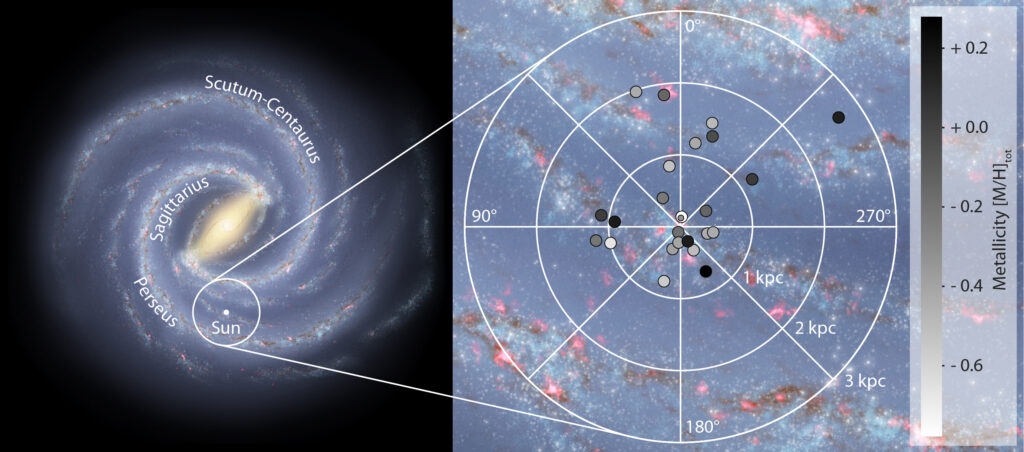
* This version of the article has been accepted for publication in Nature, after peer review, but is not the Version of Record and does not reflect post-acceptance improvements, or any corrections. The Version of Record is available at doi:10.1038/s41586-021-03780-0. Use of this Accepted Version is subject to the publisher’s Accepted Manuscript terms of use.
Gamma-ray bursts
Gamma-ray bursts (GRBs) are the most powerful explosions in the known Universe, after the Big Bang. They are observed from all directions and at a vast range of distances.
Since long GRBs (> 2 s) are believed to originate from the core-collapse of some massive stars, they can trace star formation and can be used as cosmic beacons to study their faint host galaxies in great detail, and out to high redshift. Absorption-line spectroscopy is an extremely powerful technique that can be used to unveil the chemical and kinematic properties of the gas in GRB host galaxies. See Perley et al. 2016 for a review on GRB host galaxies in emission and in absorption.
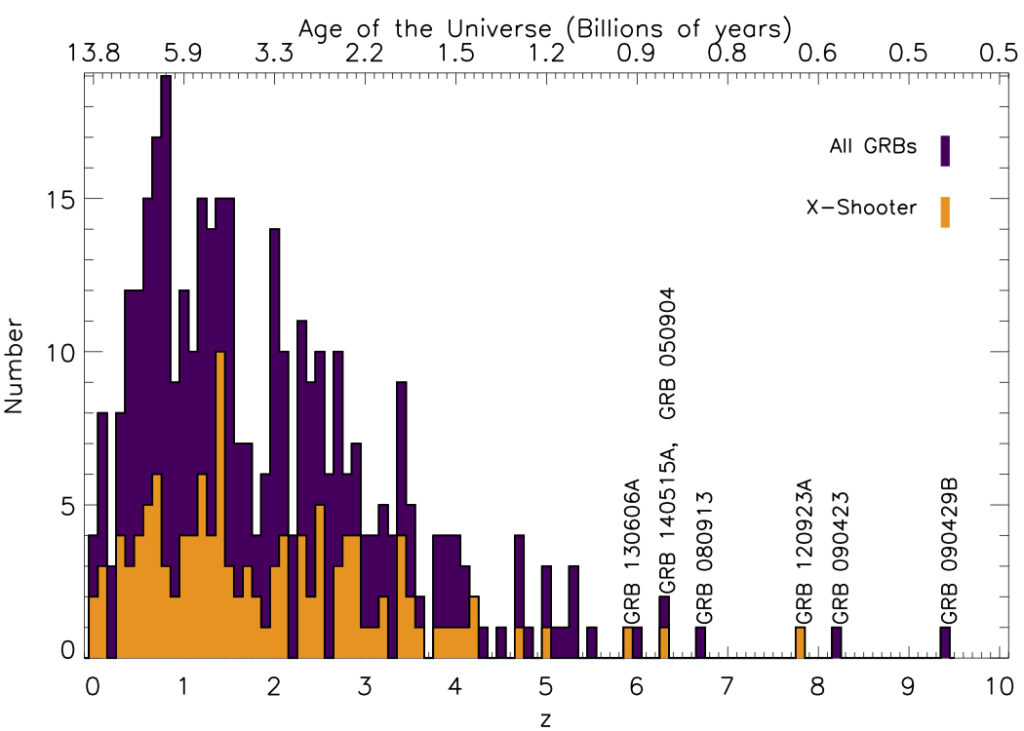
Ongoing GRB photo-ionization
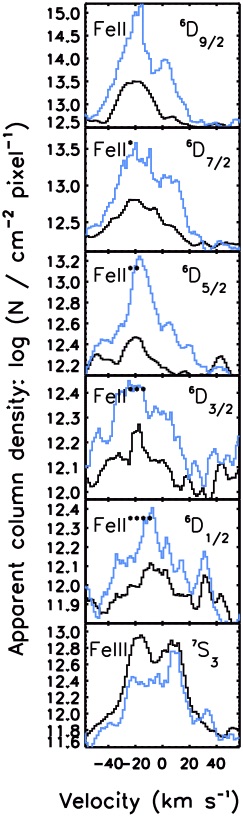
In De Cia et al. 2012 we discovered for the first time the photo-ionizing effect of a GRB on its surrounding medium, from absorption-line variability of the so-called UV34 line triplet of a highly excited FeIII level, never previously detected towards GRBs. In addition, we found that the host galaxy has very peculiar chemical properties, i.e. a marked overabundance of Fe-peak elements. This suggested episodes of massive star formation in the GRB region. In the twin paper (Vreeswijk, Ledoux, Raassen, Smette, De Cia et al. 2013), we showed the GRB radiation photo-excites and photo-ionizes the host galaxy ISM at a distance of 200–400 pc.
GRB host metallicity, in emission and absorption
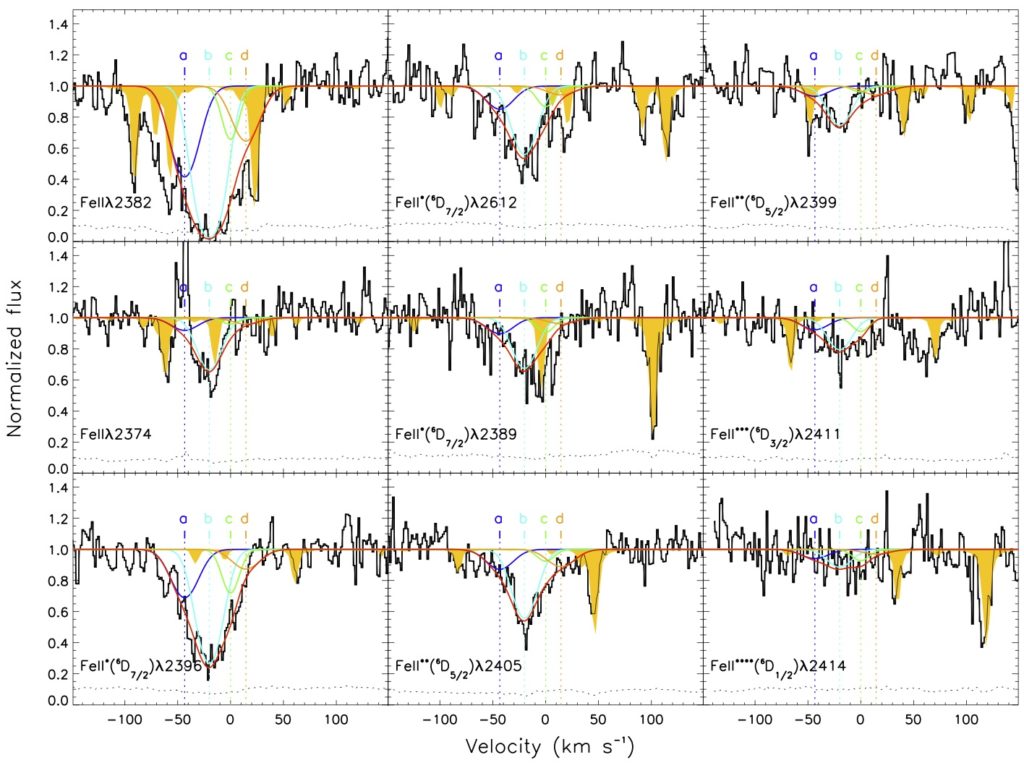
In Friis, De Cia et al. 2015 we studied the VLT/X-Shooter spectrum of GRB 121024A, a very rare case where the metallicity could be determined from both emission and absorption lines. This could in principle bring information on the GRB explosion site or help calibrating strong-emission line diagnostics at high-z. Moreover, the ISM showed multiple phases and kinematics. We detected molecular hydrogen and FeII* lines that are photo-excited by the GRB, and these two components are separated kinematically by 400 km s−1, and physically by 1–3 kpc.
Nucleosynthesis signatures in the ISM, out to z = 6
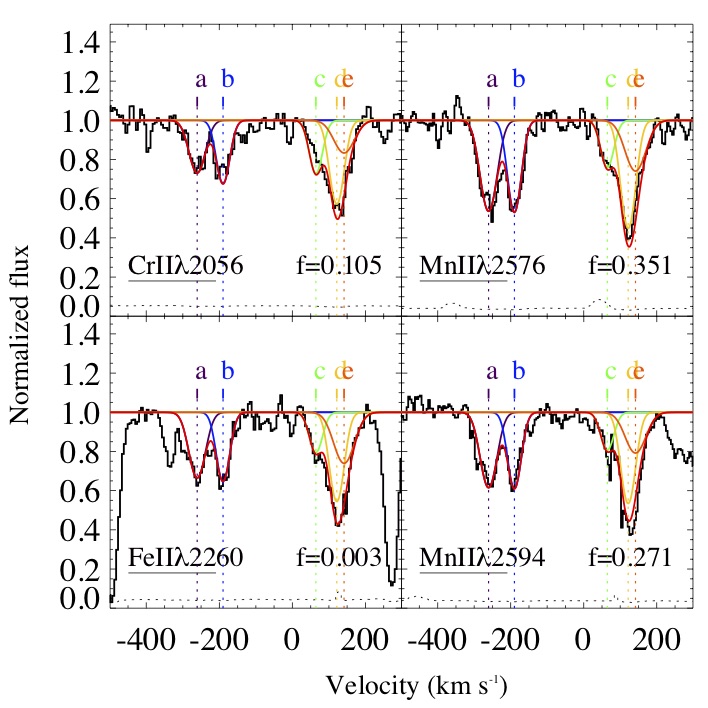
High-z GRBs give us the opportunity to explore in detail the chemical content in galaxies at the era of reionization. In the VLT/X-Shooter spectrum of GRB 130606A at z = 6 we could measure an intriguing Al overabundance (Hartoog, Malesani, Fynbo, Goto, Kruehler, Vreeswijk, De Cia et al. 2015), using the technique of De Cia et al. 2013 to interpret the metal abundances in the gas. Making proper dust corrections is crucial to be able to unveil the potentially small nucleosynthesis signatures in the ISM in GRB hosts. Two examples are Bolmer, Ledoux, Wiseman, De Cia et al. 2019 and de Ugarte Postigo et al. 2018, both using the dust corrections of De Cia et al. 2016.
Paucity of absorption lines in some GRB afterglows
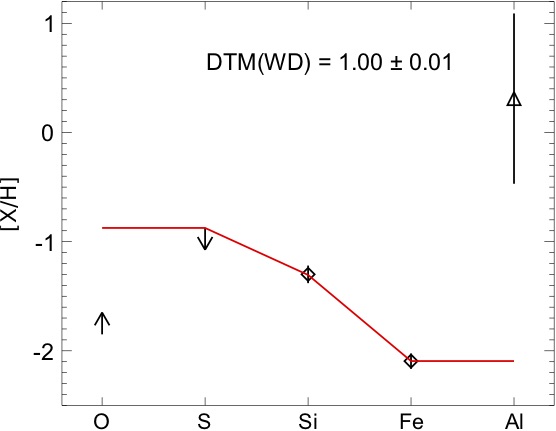
In De Cia et al. 2011b we studied the extremely energetic GRB 070125, which showed no or very weak absorption lines in the spectra. Did the GRB really explode in a halo? Probably not. In fact, weak spectral features and spectral-line poor absorbers are not so uncommon in afterglow spectra. We showed that the effect of photoionization on the gas surrounding the GRB, combined with a low N(HI) along a short segment of the line of sight within the host galaxy, can explain the lack of spectral features in GRB 070125.
Fast variability of GRB light curves
In De Cia et al. 2011a we investigated afterglow flux variability down to timescales of a few seconds, which can be caused by density fluctuations in the circumburst medium. GRB 080210 was observed with ULTRASPEC (with fast read-out, low-noise frame-transfer detectors), and revealed a smooth light curve at all time scales. Although the non-detection of variability only allowed us to place marginal constraints on the circumburst under-densities for this burst, this was a pioneering study.
Neutral ISM in galaxies
The Interstellar Medium (ISM) is a multi-phase complex that comprises gas at different temperatures and densities, including ionized, atomic, molecular gas, and dust particles.
Here the focus is on the neutral ISM, meaning the HI gas in galaxies at any redshift, which is more extended than the stellar disk both in radius and height, is dominated by HI and singly ionized metals, has relatively small velocities (within a few hundred km/s), and a small ionization fraction (typically up to 2% in the warm neutral medium in the Galaxy).
An extremely powerful way to investigate the neutral ISM out to high-z is absorption-line spectroscopy of UV/optical bright background sources, such as Quasars (QSOs). Damped Lyman-α Absorbers (DLAs, defined by N(HI) ≥ 2 × 1020 cm−2) are selected in absorption towards QSOs and associated with gas inside and around galaxies. DLAs are the largest cosmic reservoir of HI (e.g. Wolfe et al. 1995) as well as metals at z > 3 (Péroux & Howk, ARA&A in prep.). They probe neutral gas in/around galaxies of a wide range of masses, including low-mass low-metallicity distant galaxies, and their abundances can be studied in great detail in terms of metallicity, nucleosynthesis, and dust content through absorption-line spectroscopy. This makes DLAs powerful complements to the study of galaxies and their evolution.
Dust depletion in DLAs and the Galaxy
In De Cia et al. 2016 we developed a breakthrough method to characterize the metal content (dust depletion) in DLAs and the Galaxy. The method is based on the study of the relative abundances of metals, and does not assume a specific metallicity of the gas. This offers a fundamental reference for the characterization of metallicity, nucleosynthesis, and dust properties in the ISM and CGM from absorption-line spectroscopy. We also found that the DLAs with the least dust content (and lower metallicity) show α-element enhancements in their ISM which are very similar to the Galaxy levels.
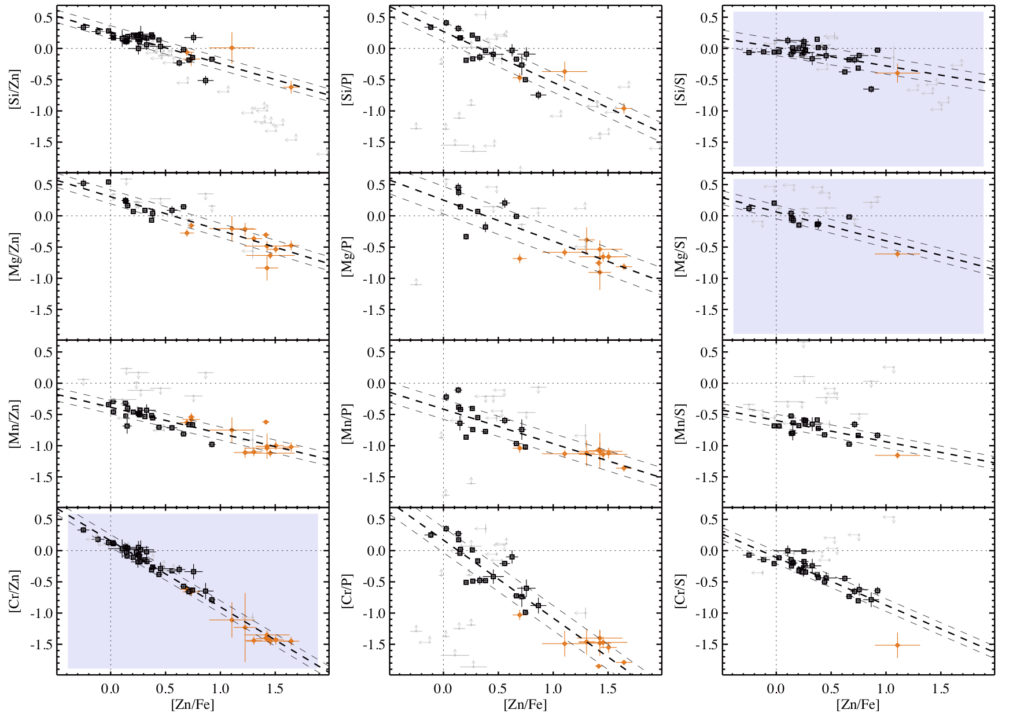
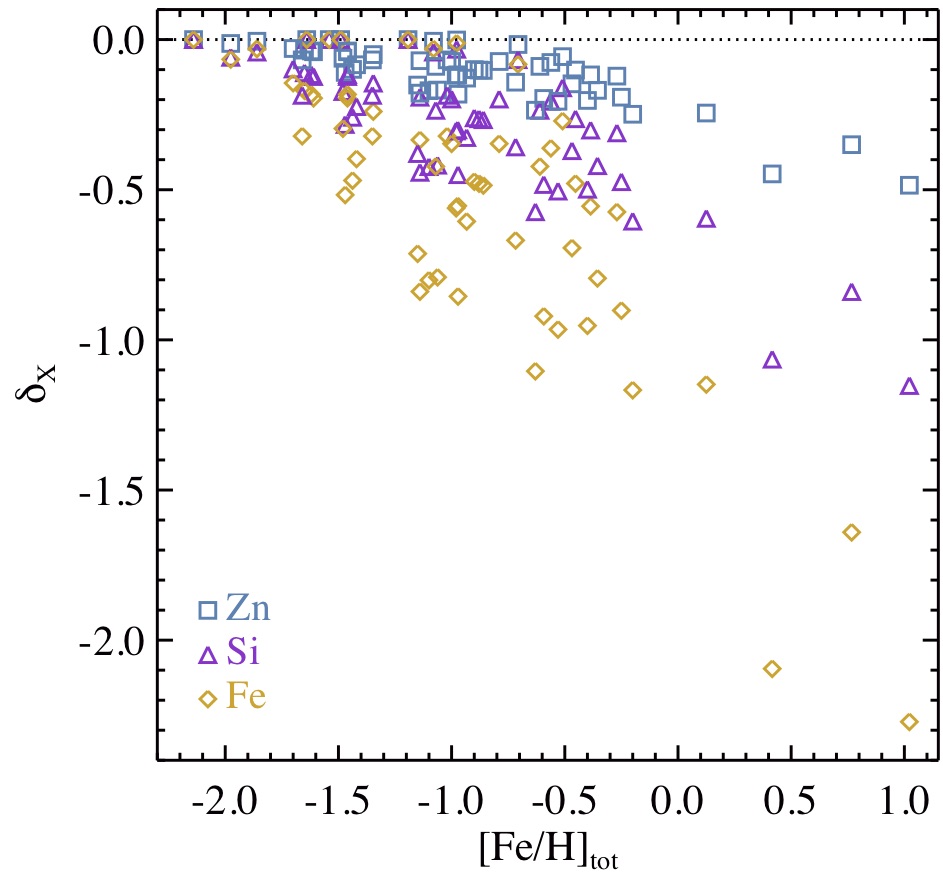
Refractory elements, i.e. those with high condensation temperatures as measured in the lab, show low abundances in the ISM in most environments, down to a small percent of the abundances of more volatile metals. As an example, 90–99% of iron is missing from the gas-phase in the Galaxy ISM. The reason is that large fractions of the refractory metals are incorporated into dust grains and are thus no longer observable in the gas phase. This phenomenon is called dust depletion (e.g. Field 1974; Phillips et al. 1982, 1984; Savage & Sembach 1996; Jenkins 2009; De Cia et al. 2016; De Cia 2018). The strength of dust depletion depends on the gas density and metal content, and it heavily affects the measurements of ISM metal abundances in any environment. In fact, dust depletion is important even for volatile elements, such as Zn, S, or O.
Cosmic chemical evolution
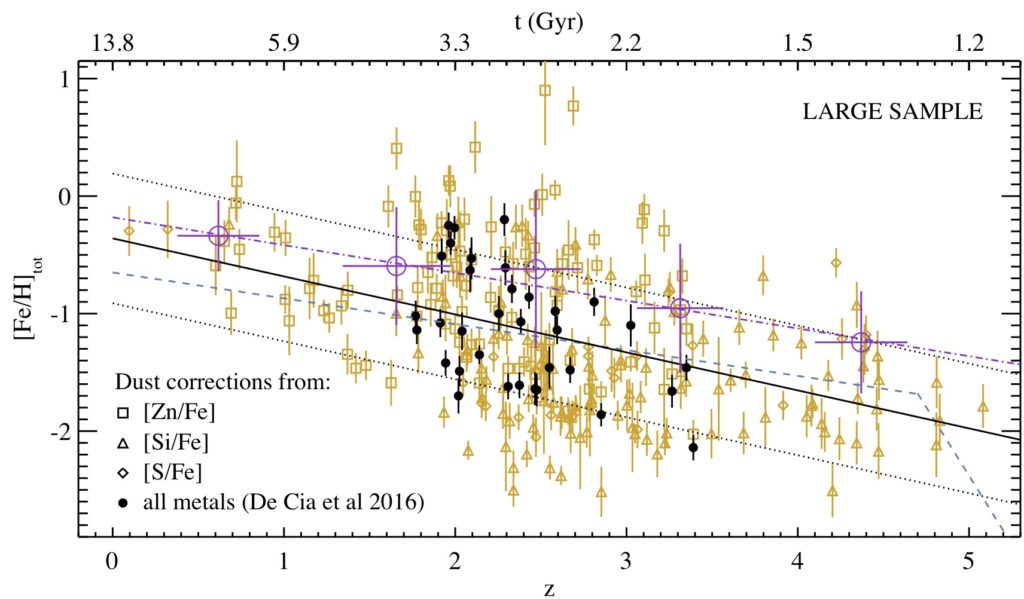
In De Cia et al. 2018a we derived the cosmic evolution of dust-corrected metallicity in the neutral gas, after correcting the observed abundances for dust depletion using our new method and a simplified version. We found that the DLA metallicities decrease with redshift, by a factor of 50–100 from today to ∼12.6 billion years ago (z = 5). When including dust corrections, the average DLA metallicities are 0.4–0.5 dex higher than without dust corrections. The upper envelope of the relation between metallicity and z reaches solar metallicity at z ≲ 0.5, although some systems can have solar metallicity already out to z ~ 3.
DLA gas chemically behaves like the ISM
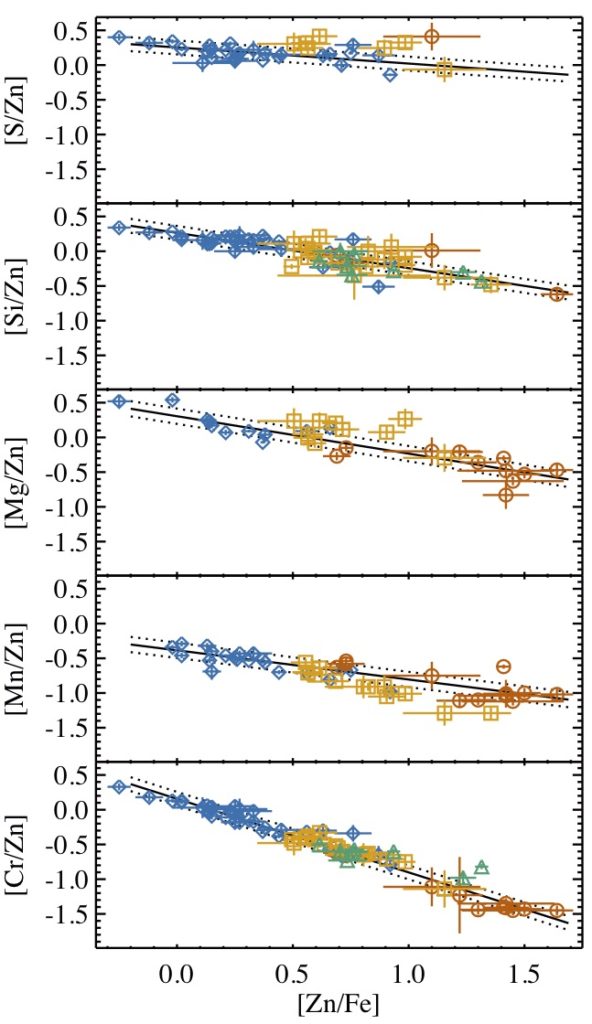
In De Cia 2018 I compared the observed relative abundances ([X/Zn], [Zn/Fe], and [O/Si]) in the Galaxy, Magellanic Clouds, and DLAs. The same sequences of relative abundances (dust-depletion sequences) are valid for the different environments. These sequences are driven by the presence of dust in the ISM and seem “universal”. The metal and dust properties in the neutral ISM appear to follow a similar behavior in different environments, regardless of the star-formation history. Thus, DLA gas behaves like the neutral ISM, at least from a chemical point of view.
Superluminous supernovae
Superluminous Supernovae (SLSNe) are a recent and rare class of supernovae that are more than 10 times brighter than normal SNe.
The inferred energetics of SLSNe require processes that are different from classical SNe, probably involving either extremely massive stars with likely very low metallicities, interaction with circumstellar material, or additional energy input from a central engine such as a magnetar or accretion onto the compact remnant. The physical mechanism powering these explosions is poorly understood and hotly debated. See Gal-Yam 2019 for a review on SLSNe.
The luminosities and light curves of SLSNe
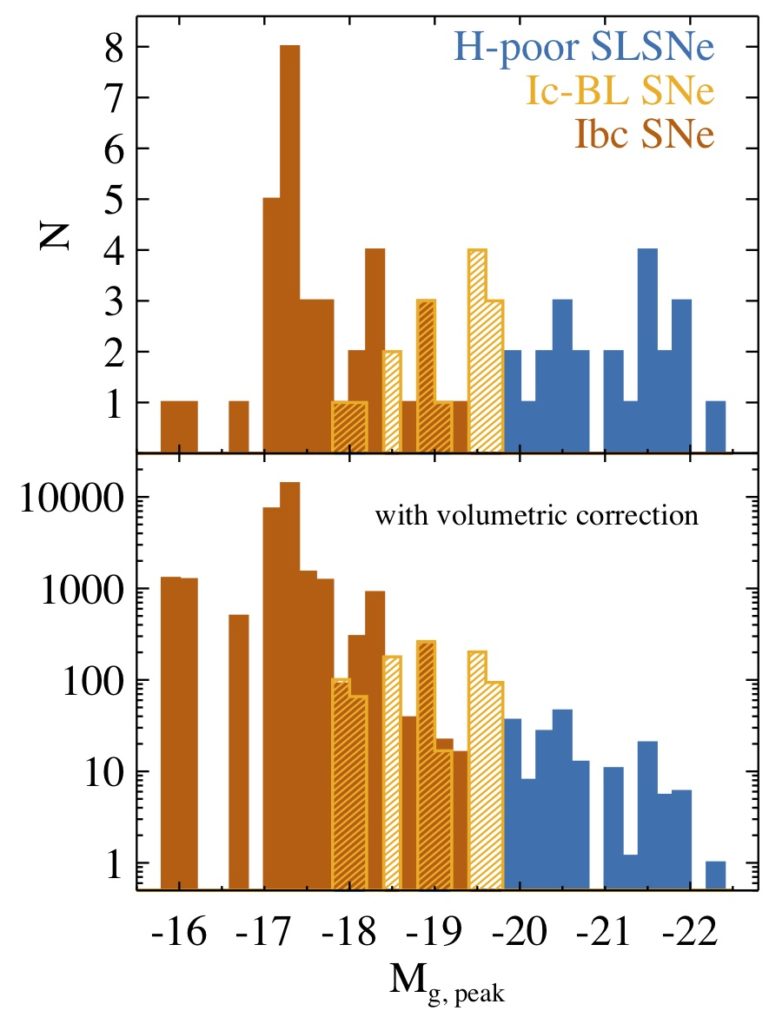
In De Cia et al. 2018b we characterized the light-curve properties of the largest and homogeneous sample of SLSNe-I (H-poor), from the (i)Palomar Transient Factory. We characterized the distribution of SLSN peak luminosities and found that H-poor SLSNe have absolute magnitudes −22 ≲ M ≲ −20 mag (rest-frame g-band). This is brighter than SNe Ib/c and SNe Ic-BL, on average, by about 4 and 2 mag, respectively. The rise timescales are longer for SLSNe-I than for normal SNe Ib/c. SLSNe-I decay with a wide range of slopes, with no obvious gap between rapidly declining and slowly declining events. At late times, the SLSN-I light curves slow down and cluster around the 56Co radioactive decay rate.
The host galaxies of SLSNe
SLSNe-I explode in low-mass and low-metallicity galaxies, with a heavily suppressed rate in galaxies with metallicities above half solar. On the other hand, SLSNe-II (hydrogen-rich) can explode in galaxies with a wide range of masses and metallicities. [Perley, Quimby, Yan, Vreeswijk, De Cia et al. 2016, SLSN host galaxies from iPTF]
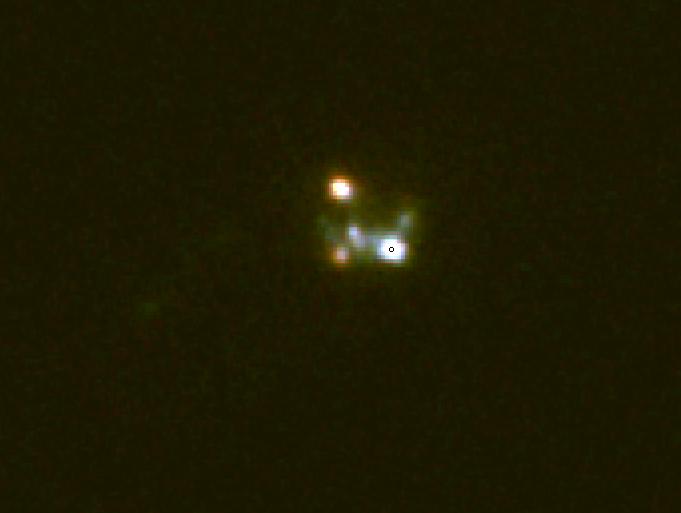
In Cikota, De Cia et al. 2017 we did a spatially resolved analysis of two nearby SLSNe-I (PTF 11hrq and PTF 12dam), using HST and VLT/MUSE data. Both host galaxies have overall blue colors, however the SLSNe did not explode in the bluest parts. PTF 11hrq exploded close to a region with disturbed kinematics, bluer color, stronger [O III], and lower metallicity, and its host galaxy is likely interacting with a companion. PTF 12dam exploded in one of the brightest pixels of a clumpy starbursting galaxy with a tidal tail. These results suggest that these SLSNe may have been produced by stars generated in episodes of star formation triggered by interaction.
The ISM in SLSN host galaxies
Mid/high-resolution spectra of SLSNe covering the rest-frame UV are scarce, but the ISM of SLSN-I hosts seems to show very narrow absorption lines, hinting at small galaxy masses. These metal lines have very low column densities or equivalent widths (Vreeswijk, Savaglio, Gal-Yam, De Cia et al. 2014). The far-UV HST spectrum of the nearby SN 2017egm showed an HI column of ~1019 cm−2, which is extremely low compared to other star-forming galaxies, such as GRB hosts, and a solar or higher metallicity of the host galaxy (Yan, Perley, De Cia et al. 2018).
The spectra of SLSNe
In Quimby, De Cia, et al. 2018 we characterized the spectral properties of SLSNe-I from the (i)Palomar Transient Factory. We found that SLSNe-I can be spectrally classified, e.g. they can be distinguished from normal supernovae based on their spectral features.
Cosmic dust
Cosmic dust is a fundamental part of the ISM, overall making up about 50% of all the metals in the ISM.
Dust is also an essential ingredient of star formation (due to the cooling effect of dust particles), planet formation (providing the first seeds of solid aggregation, e.g. Testi et al. 2014), and the formation of molecules (e.g. Cazaux et al. 2011).
The origin of dust is still a debated topic (e.g. Mattsson & Andersen 2012, Matsuura et al. 2015): whether the bulk of dust grains has been produced by winds in Asymptotic Giant Branch (AGB) stars, cooling-down SN ejecta, or growing in the ISM. However, the presence of large amounts of iron in dust, as inferred from dust depletion, challenges the possibilities of AGB stars and SNe to be the main dust producers (e.g. Dwek 2016). AGB stars seem very inefficient at producing iron-rich dust, but instead could produce iron-free silicates (e.g. Norris et al. 2012). While far-infrared and submillimeter observations of SN 1987A have suggested that core-collapse SNe can produce significant amounts of dust (0.4 – 0.7 M⊙, Matsuura et al. 2011), only a fraction of this dust may survive the SN reverse shock (e.g. Hirashita et al. 2017). In addition, no dust emission has been observed towards SNe Type Ia, where most Fe is produced.
The dust-to-metal ratio
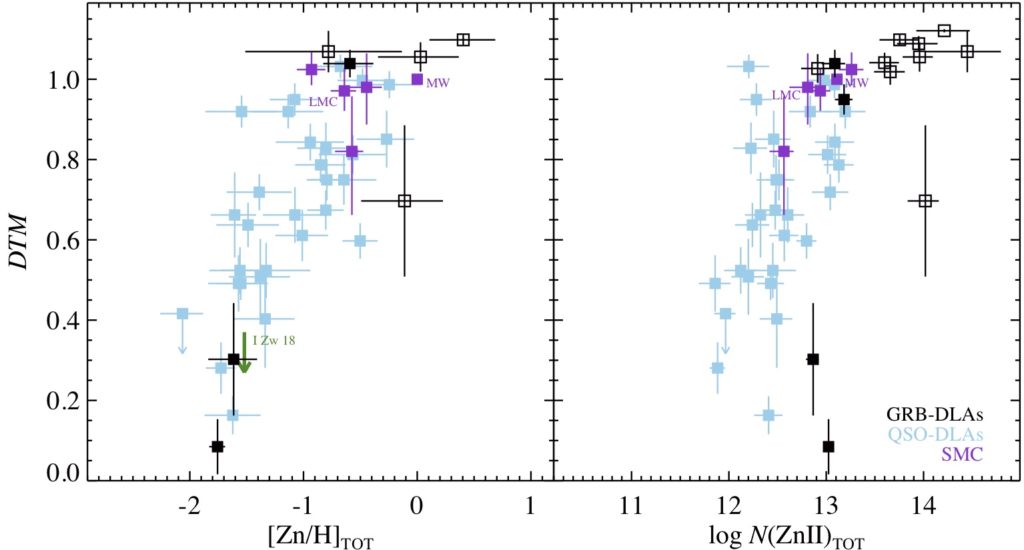
In De Cia et al. 2013 and 2016 we found that the dust-to-metal ratio (dtm) in distant galaxies (traced by DLAs and GRB host galaxies) increases with metallicity. The dtm represents the efficiency of dust production of a system given the availability of metals. The dtm can be measured with normal techniques only for local galaxies (e.g. Lisenfeld & Ferrara 1998), because it is non-trivial to measure the dust and metal masses in distant galaxies without invoking unknown conversion factors (e.g. from CO or mm/IR luminosities to dust masses). Absorption-line spectroscopy (the depletion) offers an attractive alternative to measure the dtm out to high z. Our result of an increasing dtm with metallicity in DLAs is also in agreement with the dtm measurements of the nearby low-metallicity I Zw 18 (Herrera-Camus et al. 2012).
Origin of dust
The evolution of the dtm with metallicity can help constrain models of the origin of dust, whether from stellar sources or by grain growth in the ISM. In Mattsson, De Cia et al. 2014 we found that only by including grain growth in the ISM is it possible to explain the observed dust-to-metal ratios in distant galaxies, which increase with metallicity.
Dust composition
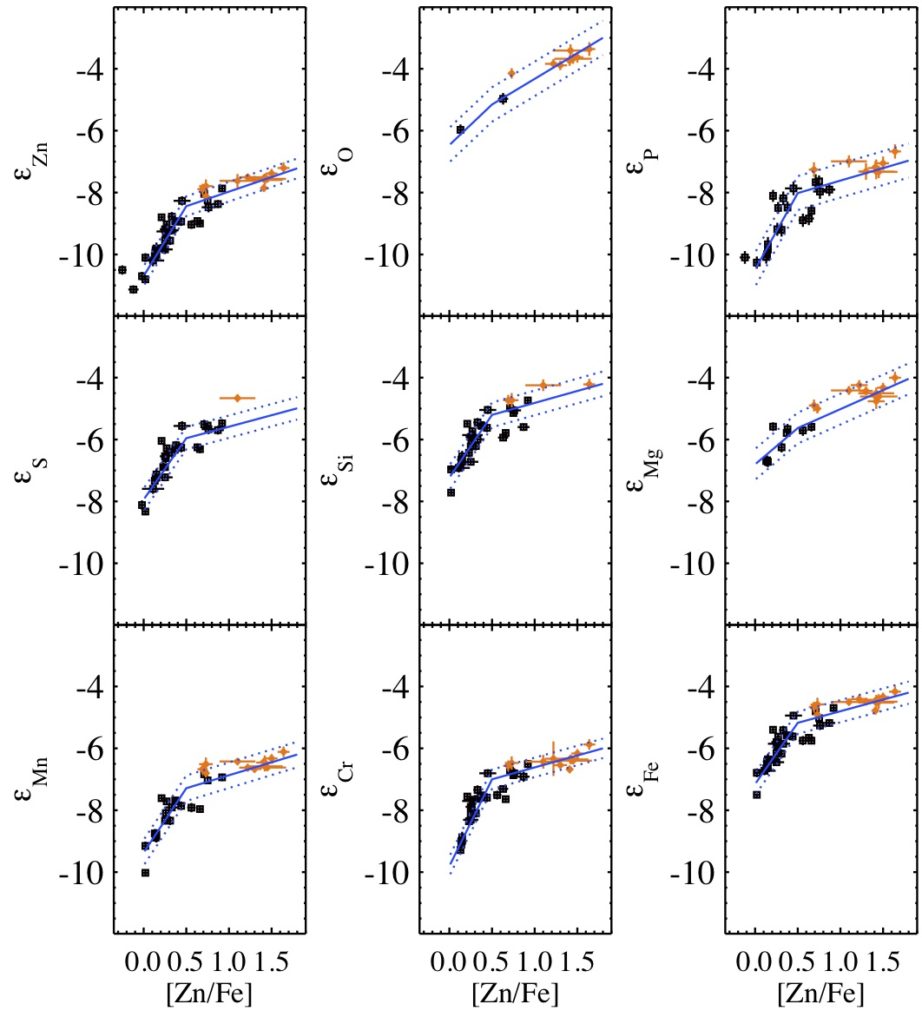
In De Cia et al. 2016 we derived the abundances in dust of different elements, based on the observed relative abundances in the gas and the dust-depletion analysis. Based on these elemental abundances in dust, in Mattsson, De Cia et al. 2019 we found that about half of the carbon-free dust should be composed of metallic iron (likely in the form of inclusions in silicate grains) and/or iron oxides (for example Wüstite) to account for the observations with a simple model. The other half is dominated by a mix of iron-poor and iron-rich olivines and pyroxenes.
Projects
HWO PEGASUS
Planets, Earths, Galaxies, And Stars UV Spectrograph
PEGASUS is a concept for a high-resolution échelle spectrograph in the ultraviolet, designed for NASA’s future Habitable Worlds Observatory (HWO). Today, high-resolution UV spectroscopy is only possible with the Hubble Space Telescope, and only for bright targets. PEGASUS aims for more than 100 times more sensitivity, opening a regime of high sensitivity and high spectral resolution that no instrument has covered so far, with a deliberately simple and robust design.
resolving power R = λ/δλ ~ 100 000 (range 10 000 – 140 000)
wavelength coverage 90 – 800 nm, with potential extension to the red
Science cases
- Planets and habitability: exoplanets and their atmospheres, protoplanetary disks, Solar System and small bodies
- Stars at their extremes: the first stars and the origin of the elements, compact and massive stars, supernovae
- Gas and metals in galaxies: the interstellar, circumgalactic and intergalactic medium and their role in galaxy growth
These goals connect to the Astro2020 Decadal Survey, ESA’s Voyage 2050 and the HWO science plan. Beyond the UV, PEGASUS would also work in the optical and at lower resolution, as a general-purpose workhorse instrument for HWO.
Paper
De Cia, A., Cont, D., Heng, K., Gänsicke, B., et al. 2026, “The future of high-resolution UV spectroscopy: Science with a UV Échelle spectrograph on the Habitable Worlds Observatory, or a dedicated mission”, submitted to RASTI: arXiv:2609.09329
STIS-ISM
STIS ISM Survey in the Milky Way
Hubble Space Telescope Large Programme GO 17703 · Cycle 32 · 111 orbits · PI: Annalisa De Cia
For a long time the neutral interstellar gas of the Milky Way was assumed to be chemically well mixed. Today that picture is debated: some studies find pockets of metal-poor gas, likely from gas falling onto the disk, while others find gas close to solar composition everywhere. Many sightlines also look complex, because several gas clouds with different metal and dust content overlap along the line of sight.
STIS-ISM uses the ultraviolet spectrograph STIS on board Hubble to observe bright, hot OB stars and study the gas in front of them in absorption.
Goals
- Cloud by cloud: measure how the metal content varies from one gas cloud to the next, with the highest spectral resolution
- Across the disk: measure the metallicity gradient of the neutral gas, towards stars at large distances from the Galactic Center, a region barely explored so far, and compare the gas with the stars themselves
- A UV legacy: the high-resolution STIS spectra will remain unmatched for decades
The programme is carried out by an international team of ~30 researchers, including members of the former INTERSTELLAR ONE group.
Programme page at STScI: HST GO 17703
STIS-ISM website: coming soon
INTERSTELLAR ONE
Welcome to “INTERSTELLAR ONE: One vision for the interstellar medium at all cosmic times”. Our journey took us to study gas, metals (the chemical elements heavier than He) and cosmic dust in the Interstellar Medium (ISM) of nearby and distant galaxies.
Gas has a fundamental role in the formation and evolution of galaxies, the building blocks of our Universe. The chemical elements in this gas are key for the formation and evolution of stars, cosmic dust, molecules, planets, and life. But gas is faint and elusive to observe. Absorption-line spectroscopy is an incredibly powerful tool to investigate the gas, metal, and dust content inside and around galaxies, both in the local and distant Universe. However, understanding the chemical abundances in the neutral gas has been a great challenge until recently, because of the presence of dust grains.
In INTERSTELLAR ONE we overcame this challenge by studying the relative abundances of chemical elements, and used this to study the properties of metals and dust in the neutral gas in galaxies, from our Milky Way to the very distant Universe. Importantly, this includes low-mass distant galaxies, which are the most numerous but are typically missed in flux-limited studies. And this has strong implications on the study of the chemical evolution of galaxies and the cosmic chemical evolution.
We mostly used absorption-line spectroscopy of optical and UV observations of Quasars, gamma-ray bursts (GRBs), and stars, from high-resolution spectrographs of the Very Large Telescope and the Hubble Space Telescope to unveil the chemical properties of gas inside and around galaxies.
The project INTERSTELLAR ONE was supported by a PRIMA grant of the Swiss National Science Foundation between January 2020 and December 2024, at the University of Geneva.
INTERSTELLAR ONE Team
The INTERSTELLAR ONE Team at the University of Geneva (2020–2024).





INTERSTELLAR ONE Results
A summary of what the INTERSTELLAR ONE group found between 2020 and 2024, funded by the Swiss National Science Foundation (SNSF PRIMA grant PR00P2_185692). The common thread is a method from De Cia et al. 2016: different metals are incorporated in dust grains to different degrees, so their relative abundances reveal how much of each metal is hidden in dust, without assuming the metallicity of the gas. This opened a new way to study the chemistry of interstellar gas, from the Milky Way to the most distant galaxies.
1. The gas in galaxies is not chemically uniform
- The Milky Way is not well mixed. Measuring the dust-corrected metallicity of the neutral gas towards 25 stars, with Hubble (GO 15335) and archival VLT data, showed large variations, most likely caused by pristine gas falling onto the disk (De Cia et al. 2021, Nature, see also Our Milky Way? Not well stirred).
- Cloud by cloud. Higher-resolution Hubble spectra of eight sightlines (GO 16750) and a cloud-by-cloud analysis revealed metallicity differences of about a factor of 10 between individual clouds (Ramburuth-Hurt et al. 2025). This pilot project led to the Hubble Large Programme STIS-ISM.
- Distant galaxies too. Within single distant galaxies (damped Lyman-α absorbers, DLAs), the amount of dust depletion varies significantly from region to region (Ramburuth-Hurt et al. 2023).
2. Massive stars shape the chemical enrichment
- Magellanic Clouds: an excess of α-elements (such as Mg, Si and S, made mostly by massive stars exploding as supernovae) points to a recent burst of star formation (De Cia et al. 2024).
- Distant galaxies: DLAs also show α-element enhancement, and more massive galaxies reach the α-element “knee” at higher metallicity, as galaxy chemical evolution models predict (Velichko et al. 2024).
- The early Universe: the host galaxy of a gamma-ray burst at z = 6.3, when the Universe was about 10% of its current age, shows a very high α-element abundance and an unusual excess of aluminium, possibly linked to very massive stars (Saccardi, Vergani, De Cia et al. 2023).
3. How metals hide in dust
- An atlas of dust depletion for 18 metals, from the Milky Way and the Magellanic Clouds to distant galaxies seen towards quasars and gamma-ray bursts, now a reference for the field; before, this had been done for only nine elements (Konstantopoulou et al. 2022).
- What cosmic dust is made of: by mass mainly O, Fe, Si, Mg, C, S, Ni and Al (Konstantopoulou et al. 2024a).
- DUNE, a unified method that combines the strengths of the two established approaches to dust depletion and overcomes their limits (Konstantopoulou et al. 2024b).
- Putting clouds on the map: for the first time, dust depletion in individual clouds was linked to 3D dust-extinction maps, locating clouds such as the Orion Nebula and the surface of the Local Bubble (Ramburuth-Hurt et al. 2026).
- Across cosmic time: the build-up of metals and dust in galaxies (Heintz, De Cia et al. 2023) and the cosmic dust surface density (Péroux, De Cia & Howk 2023).
4. Models and simulations
- Gamma-ray burst host galaxies and quasar absorbers trace the same population of star-forming galaxies, but gamma-ray bursts pick out denser, dustier and colder gas, likely during brief phases of enhanced star formation (Krogager et al. 2024).
- The chemistry of DLA galaxies agrees broadly with chemodynamical simulations (GEAR), including the α-element knee shifting with galaxy mass (Velichko et al. 2026).
In numbers
- 17 published or accepted articles
- 2 PhD theses (Christina Konstantopoulou, Tanita Ramburuth-Hurt) and 2 Master theses (Iris Jermann 2022, Laurent Dalla Pola 2024)
- Hubble programme GO 16750 and the Hubble Large Programme STIS-ISM (GO 17703)
Project page with abstract, team and full list of outputs: SNSF Data Portal, grant 185692
All papers: Publications
Women in Science
Women in Science: Experiences of Academics in Switzerland
edited by Annalisa De Cia, Sara Hellmüller and Elizabeth Mesok Khan
Twelve women scholars from universities and disciplines across Switzerland describe their paths towards a professorship: the structural inequalities, competition and difficult cultures they met along the way, and the passion and perseverance that kept them going. The book is meant as encouragement for anyone still finding their place in science. With a foreword by Cassidy Sugimoto. Annalisa’s own chapter is Chapter 4: Chasing That Sparkle of Passion.
transcript Verlag, 12 August 2025 · 126 pages · open access (CC BY), funded by the SNSF
DOI: 10.14361/9783839405390
Read or download the book (free PDF)
Publications
Full publication record
- More than 200 records (more than 50 refereed publications): NASA ADS
- ORCID: 0000-0003-2082-1626
- h-index: 42 (SciX / NASA ADS, November 2026)
Selected publications
- De Cia A., Cont D., Heng K., Gänsicke B., et al. 2026, submitted to RASTI, arXiv:2609.09329, “The future of high-resolution UV spectroscopy: Science with a UV Échelle spectrograph on the Habitable Worlds Observatory, or a dedicated mission” (HWO PEGASUS)
- De Cia A., Jenkins E.B., Fox A.J., Ledoux C., Ramburuth-Hurt T., Konstantopoulou C., Petitjean P., Krogager J.K. 2021, Nature, 597, 206, “Large metallicity variations in the Galactic Interstellar Medium”
Refereed publications as first or second author
- Ramburuth-Hurt T., De Cia A., et al. 2026, A&A, 710, A64, “Connecting the dusty dots: dust depletion and extinction of local interstellar clouds”
- Ramburuth-Hurt T., De Cia A., et al. 2025, A&A, 695, A14, “Investigating chemical variations between interstellar gas clouds in the Solar neighbourhood”; Corrigendum: 2026, A&A, 707, C3
- Krogager J.-K., De Cia A., et al. 2024, MNRAS, 535, 561, “Modelling of long gamma-ray burst host galaxies at cosmic noon from damped Lyman-α absorption statistics”
- Konstantopoulou C., De Cia A., Krogager J.-K., et al. 2024, A&A, 691, A129, “DUNE: Dust depletion UNified method across cosmic time and Environments”
- Velichko A., De Cia A., Konstantopoulou C., et al. 2024, A&A, 685, A103, “The α-element enrichment of gas in distant galaxies”
- De Cia A., Roman-Duval J., Konstantopoulou C., et al. 2024, A&A, 683, A216, “α-element enhancements in the ISM of the LMC and SMC: Evidence for recent star formation”
- Konstantopoulou C., De Cia A., et al. 2024, A&A, 681, A64, “Dust depletion of metals from local to distant galaxies II: Cosmic dust-to-metal ratio and dust composition”
- Heintz K.E., De Cia A., et al. 2023, A&A, 679, A91, “The cosmic build-up of dust and metals. Accurate abundances from GRB-selected star-forming galaxies at 1.7 < z < 6.3”
- Péroux C., De Cia A., Howk J.C. 2023, MNRAS, 522, 4852, “Observed dust surface density across cosmic times”
- Ramburuth-Hurt T., De Cia A., et al. 2023, A&A, 672, A68, “Chemical diversity of gas in distant galaxies: The metal and dust enrichment and variations within absorbing galaxies”
- Konstantopoulou C., De Cia A., et al. 2022, A&A, 666, A12, “Dust depletion of metals from local to distant galaxies I: Peculiar nucleosynthesis effects and grain growth in the ISM”
- Mattsson L., De Cia A., Andersen A.C., Petitjean P. 2019, A&A, 624A, 103, “Dust-depletion sequences in damped Ly-α absorbers II. The composition of cosmic dust, from low-metallicity systems to the Galaxy”
- De Cia A., Gal-Yam A., Leloudas G. et al. 2018b, ApJ, 860, 100, “Light curves of hydrogen-poor Superluminous Supernovae from the Palomar Transient Factory”
- De Cia A. 2018, A&A Letter, 613L, 2, “Metals and dust in the neutral ISM: the Galaxy, Magellanic Clouds, and Damped Lyman-α absorbers”
- De Cia A., Ledoux C., Petitjean P., Savaglio S. 2018a, A&A, 611, A76, “The evolution of cool ISM metallicity with cosmic time”
- Quimby R., De Cia A., et al. 2018, ApJ, 855, 2, “Spectra of hydrogen-poor Superluminous Supernovae from the Palomar Transient Factory”
- Cikota A., De Cia A., Schulze S., Vreeswijk P.M., Leloudas G., Gal-Yam A., et al. 2017, MNRAS, 469, 4705, “Spatially resolved analysis of superluminous supernovae PTF 11hrq and PTF 12dam host galaxies”
- De Cia A., Ledoux C., Mattsson L., Petitjean P., Srianand R., Gavignaud I., Jenkins E.B. 2016, A&A, 596A, 97, “Dust-depletion sequences in damped Lyman-α absorbers: A unified picture from low-metallicity systems to the Galaxy”
- Friis M., De Cia A., Krühler T., Fynbo J.P.U., Ledoux C., Vreeswijk P.M., Watson D.J., et al. 2015, MNRAS, 451, 167, “The warm, the excited, and the molecular gas: GRB 121024A shining through its star-forming galaxy”
- Mattsson L., De Cia A., Andersen A.C., Zafar T. 2014, MNRAS, 440, 1562, “On the (in)variance of the dust-to-metals ratio in galaxies”
- De Cia A., Ledoux C., Savaglio S., Schady P., Vreeswijk P.M. 2013, A&A, 560, A88, “Dust-to-metal ratios in damped Lyman-α absorbers. Fresh clues to the origins of dust and optical extinction towards gamma-ray bursts”
- De Cia A., Ledoux C., Fox A.J., Vreeswijk P.M., Smette A., Petitjean P., Björnsson G., et al. 2012, A&A, 545, A64, “Rapid-response mode VLT/UVES spectroscopy of super iron-rich gas exposed to GRB 080310. Evidence of ionization in action and episodic star formation in the host”
- De Cia A., Starling R.L.C., Wiersema K., van der Horst A.J., Vreeswijk P.M., Björnsson G., de Ugarte Postigo A., et al. 2011, MNRAS, 418, 129, “GRB 070125 and the environments of spectral-line poor afterglow absorbers”
- De Cia A., Jakobsson P., Björnsson G., Vreeswijk P.M., Dhillon V.S., Marsh T.R., Chapman R., et al. 2011, MNRAS, 412, 2229, “Probing gamma-ray burst environments with time variability: ULTRASPEC fast imaging of GRB 080210”
Jobs
At this moment there are no available PhD or Postdoc positions in our group.
Contact
Dr. Annalisa De Cia
ESO Headquarters
Karl-Schwarzschild-Str. 2
85748 Garching bei München
Germany
email: Annalisa.DeCia@eso.org